Last summer, a group of friends expressed interest in touring Kenya. Excited by the opportunity, I invited them to join Educultural Travel.
Educultural Travel is the soul of the International African School. We don’t just show places. We invite people into stories, into moments that linger. Our journeys braid together learning and living, so every moment in Kenya feels alive and unforgettable.
One guest, a teacher, was especially eager. Her questions about Kenyan schools never seemed to end. After a flurry of phone calls, I arranged for us to visit two schools: Brookhouse, polished and proud, and a tiny school tucked deep in Mathare, Nairobi’s beating heart. I thought I was ready for the contrast. I wasn’t.
We set out for Mathare at dawn. The city yawned awake as we drove. Our driver, Lawrence, navigated streets that shifted before our eyes—green, quiet suburbs melting into a maze of narrow lanes and restless crowds. The car filled with laughter, but outside, the city’s pulse grew louder, and an uneasy thrill threaded through us.
Mathare was alive in every sense. Women balanced sacks high on their backs, weaving through a river of people. Men hurried past with fresh meat, blood flickering in the morning sun. Shops spilled onto the street, vegetables stacked in bright pyramids, the sharp scent of soap and spices, snatches of music and laughter. Chaos, and yet, a kind of beauty.
Inside the car, we grew quiet. Our eyes found each other—some wide with wonder, others shadowed by worry. No one needed words; the air was thick with questions.
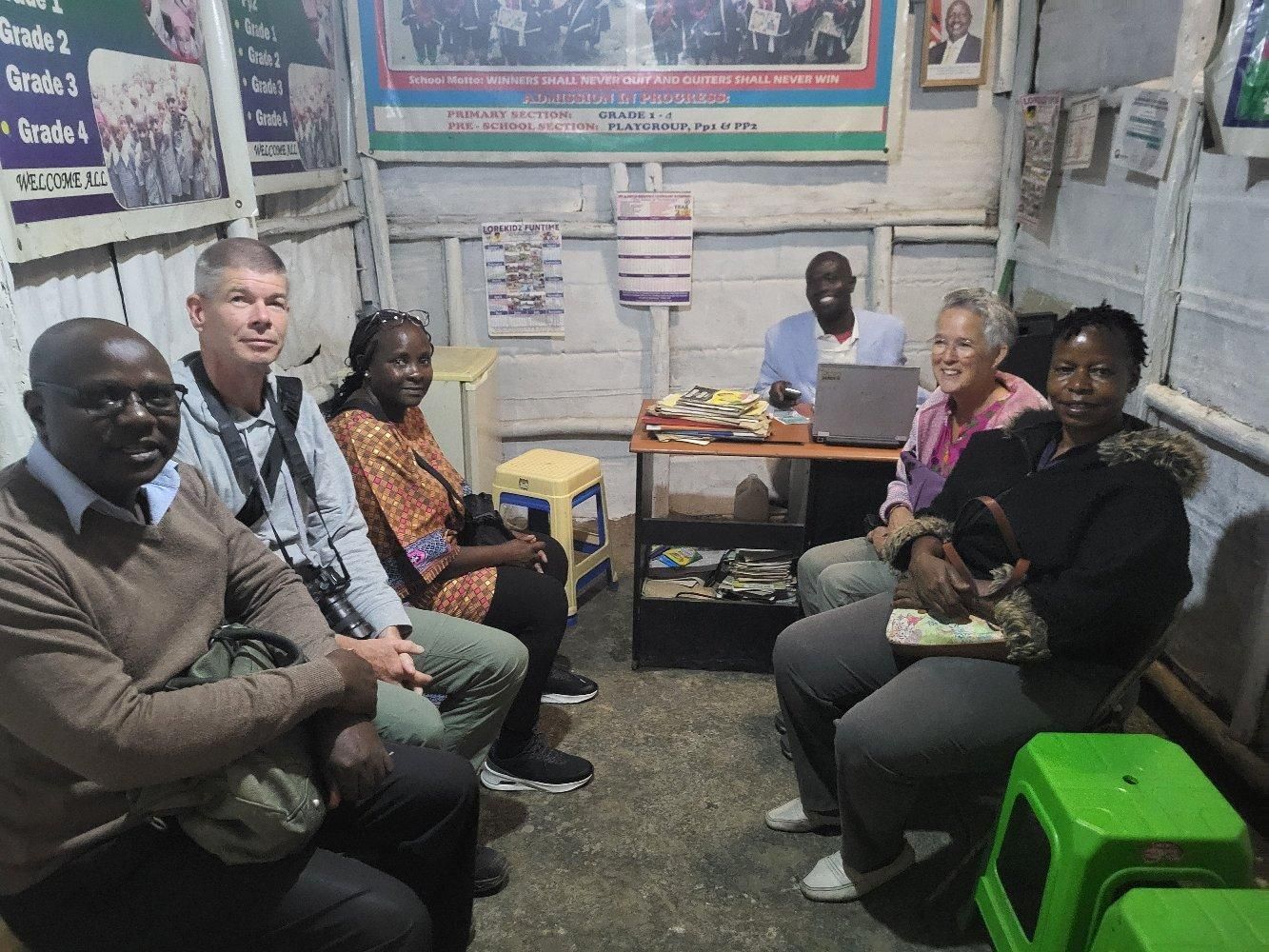
“We’re here,” Lawrence said softly. We peered out, expecting a building, but saw only shacks patched with iron sheets and children waiting in the dust. When they saw us, they burst into song—clear voices, bright as the sun. For a moment, we forgot everything and danced. Then we were led inside. The school was a maze of darkness, tin walls rusted and rooms tight as fists. The smell hit us hard. As we shuffled toward the principal’s tiny office, dozens of eyes followed us—curious, hopeful, and shining.
The principal, eyes bright with pride, welcomed us. We squeezed into room after room, each one darker, smaller, emptier than the last. Even I, a child of this land, had never seen such learning conditions. We then hurdled into the Principal’s office and sat quietly listening to the school's history. Words failed us when we were asked to say something. Silence broke, and tears came, quietly at first, then freely. In that moment, our hearts spoke the same language.
The teachers were there, gentle and steady. They taught with nothing but their voices and hope, chalk dust on their fingers, stories in their eyes. The children listened, learning by heart because there were no books—only memory and dreams.
I whispered, “Where’s the toilet?” The answer was a sigh: “We borrow from neighbors, when they let us.”
Suddenly, the smell made sense. The teachers could go; the three hundred children could not. The problem was everywhere, and nowhere to hide.
But hope did not leave this place. The community gave what they could, teachers gave what they had, and somehow, the school survived, held together by kindness and faith.
We left too soon. My mind clung to the girl in yellow by the door. What would her tomorrow look like? How could we help? Who would fight for these children? The questions trailed us home, heavy as dusk, begging not to be forgotten.
Yet, questions burned inside me, sharper than ever.
To those living in comfort, I ask: Whose children are meant to sit in darkness, to breathe in hope and dust? While your sons and daughters learn behind golden gates, shielded from want, do you see these faces? Is Kenya only for those who can pay the price? Or is it, truly, for every child who wakes up dreaming beneath her sky?
I urge the government: look again at our schools. When we sell off education and health, we loosen the very bricks that hold our nation together. If a nation forgets its children, whose future are we building? Every child carries a spark; every child can learn. But when we build walls between the rich and poor, we dim that spark—and weaken the future for us all.
Let’s step back in time. It’s 1964, and Kenya is free; hope is everywhere. But today, most public classrooms still stand on foundations built by missionaries, not the state. Private schools are growing quickly, and every year, more families are left behind. Take a moment to think: what do we lose when education is something you have to buy? Let’s look at the risks together, one at a time:
- First, imagine two children starting the same race. One has sturdy shoes, the other is barefoot. When schools cost more than hope, the gap between rich and poor becomes impossible to cross.
- Second, think about trust. Citizens pay taxes expecting good schools. But what happens when classrooms are sold to the highest bidder? In places like Haiti, most schools are private, and trust in government quietly fades away.
- Third, what ties a country together? In Singapore, unity is built in classrooms where every child learns side by side. If Kenya’s schools are divided by money and tribe, how can we ever share the same story?
- Fourth, think about the future. What will happen if our public schools disappear? Without them, innovation slows, skills fade, and our nation’s heartbeat weakens. When profit comes first, everyone else is left behind.
- Fifth, who is in charge? In a private system, those with power make the rules. Politicians listen to lobbyists instead of parents or children.
- Picture a country with many classrooms, each teaching a different story. When the government steps back, others take over, breaking apart our future and weakening what connects us.
In the end, education is not just a service—it’s the foundation for every dream, every job, every anthem we sing together. When we let go of that foundation, what’s left?
Bibliography
Anderson, Benedict. Imagined Communities: Reflections on the Origin and Spread of Nationalism. London: Verso, 1983.
Besley, Timothy, and Torsten Persson. Pillars of Prosperity: The Political Economics of Development Clusters. Princeton, NJ: Princeton University Press, 2011.
Green, Andy. Education and State Formation: The Rise of Education Systems in England, France, and the USA. London: Macmillan, 1990.
Heyneman, Stephen P. “The History and Problems in the Making of Education Policy at the World Bank 1960–2000.” International Journal of Educational Development 23, no. 3 (2003): 315–337.